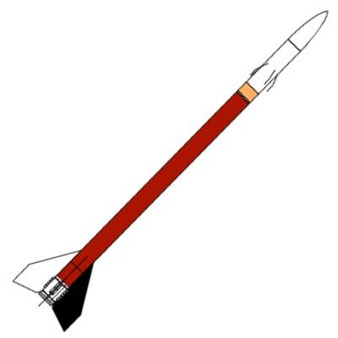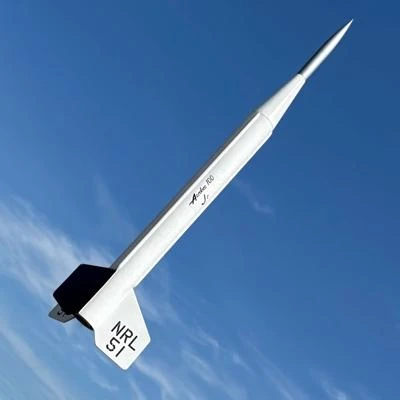


ASP Flying Model Rocket Kit Aerobee 100 Junior 29mm ASP KAERJR-29
The Aerobee 100, or Aerobee Junior, was first flown early in 1958. This vehicle was designed by Aerojet General to be an inexpensive rocket to fly payloads of 50 - 100 pounds up to 90 miles. This model represents the upper stage of the vehicle that was flown on February 18, 1958.
Aerobee rockets have long been a favorite of scale modelers. This updated kit is 1.89" in diameter and about 2 1/2 feet tall and features thru-the-wall laser-cut plywood fins (with optional balsa laminations), 3D printed transition and nose cone, pre-rounded basswood conduits, steel cable shock cord mount and water slide decals. This model has been recently updated to conform to newly published scale data.
Makes a great intro to mid-power rocketry and flies fantastic (and high!) on 29mm F and G engines! This model can reach some impressive altitudes, especially with G engines, so you might consider the Jolly Logic Chute Release a good add-on to this kit if you plan on using the higher-impulse engines. The kit has an accurate scale outline but is also a fairly easy build.
Specifications:
3D Printed Nose Cone
Length: 29.5"/75 cm
Diameter: 1.89”/4.8 cm
Approx. Weight: 9 oz/255 gm
Recommended Parachute: 18" or 24" Nylon (Not Included)
Scale: approx. 1/7.94 (0.126)
Skill Level: Intermediate
Center of Pressure: 24.5" from tip of nose
Requires 1/4" Launch Rod
Recommended Engines: E16-4; F15-4; F20-7; F23-7; F42-8; G77-10; G78-10; G79-10; G80-10; with 24mm adapter (not included): E20-4; F30-6; F32-6; F44-4
Estimated (Calculated) Altitudes:
with E16-4: 855'/255m
with E20-4: 995'/303m
with F15-4: 1245'/380m
with F20-7: 1875'/572m
with F23-7: 1160'/354m
with F30-6: 1425'/434m
with F32-6: 1740'/530m
with F42-8: 1720'/524m
with F44-8: 1350'/411m
with G77-10: 2590'/791m
with G78-10: 2750'/838m
with G79-10: 2695'/821m
with G80-10: 2980'/908m
What you'll need to build this model:
Adhesives (Epoxy, Quick or Medium Setting, can be used and is recommended for most construction. Thin Cyanoacrylate ["CA"] is recommended for two steps.); Hobby Knife with sharp #11 Blade; Ruler; Pencil; Aluminum (or other metal) angle - ideally 1" X at least 18" long; electric drill with 1/16" (or 3/32") and 5/32" (or 3/16") bits; Wax Paper (or Plastic Wrap); Pliers; Masking Tape; Sandpapers (Coarse - 80 or 100 grit, Medium - 180 or 220, Fine 320 or 400, & [optionally] Extra-Fine - 500 or 600); Sanding Sealer (or other balsa filler coat); Thinner (appropriate for the type of sanding sealer used); Small Paint Brush (to apply sealer); Spray Paint (such as Rust-Oleum, Krylon, or Testors is recommended. Be sure not to mix different types or brands of paint without testing.) - primer (optional), white, black, aluminum (or silver), and clear (optional).
Recommended, but not required: Sanding Block; Tack Cloth; External Engine Retainer (such as Estes Pro Series II™ 29 mm Motor Retainer Set).
Optional: Material to fill body tube seams and/or any imperfections in wood parts, such as Elmer’s Carpenters Wood Filler, Interior Spackling Paste, etc.
What else you'll need to fly this model:
Electronic launch system capable of igniting a composite engine; launch pad with 1/4" launch rod; 18" or 24" nylon parachute; recovery wadding or cloth parachute protector; engines (see list of recommended engines above).
Made in the USA